Turning Marketing into a Scalable Revenue Engine for Maple Assist

 Maple Assist case study - Markivis performance marketing for the Canadian education sector

The challenge Maple Assist, a global educational partner connecting universities with Indian students, faced a pivotal challenge. Their marketing activities were consuming significant resources without delivering measurable returns. They lacked the infrastructure to launch new service lines efficiently, and as a startup, needed to build brand presence while preserving limited resources.

The challenge

Maple Assist came to us in classic startup shape: spending on marketing, seeing some leads, but unable to draw a straight line between the two. As a global education partner connecting Canadian universities with Indian students, they needed two things at the same time - visible brand credibility in a market where they were still unknown, and a lead engine efficient enough not to burn through a startup's runway.

The deeper problem was structural. Maple Assist's growth wouldn't come from selling one service to one audience. It would come from stacking new service lines on top of each other, and each new line needed its own funnel - without the founding team rebuilding marketing from scratch every single time. Without a revenue-focused engine underneath, their marketing was at risk of becoming a cost center instead of a growth driver. That is a familiar trap for education-sector startups chasing fast scale.

The solution

We built a revenue-driven marketing model designed to turn Maple Assist's marketing from a cost center into a profit contributor - and we picked channels based on where Indian students planning to study in Canada actually spend their time, then ran them hard.

  • Facebook - the volume engine. High-reach audience targeting against Indian students considering Canada, with creative built around the doubts that surface during the consideration phase: visas, cost of living, post-study work rights, family pressure. Facebook gave us the volume that made the cost-per-lead math work.
  • Instagram - aspiration and trust. Where Facebook carried volume, Instagram carried aspiration. Campus reels, day-in-the-life content from current students, and partner brand moments built the emotional pull that turns awareness into intent.
  • Quora - the efficiency play. This is the channel most agencies underuse for this audience, and it's the one that pushed our cost per lead down further than expected. Indian students don't begin their study-abroad research on Facebook - they begin it on Quora, deep in threads about visa rejection rates and college rankings. We ran Quora ads, but more importantly we ran a sustained organic answers program. An answer written in month two was still generating leads in month eight, at zero additional spend.
  • Google Ads - capturing intent. For bottom-of-funnel demand. Searches like 'study in Canada from India' carry intent that doesn't need to be manufactured. We bid for it and converted it.
  • Technical enablement for new service lines. We delivered custom online solutions so each new business line Maple Assist launched arrived with its own measurable, revenue-focused funnel - not a fresh marketing rebuild every time.
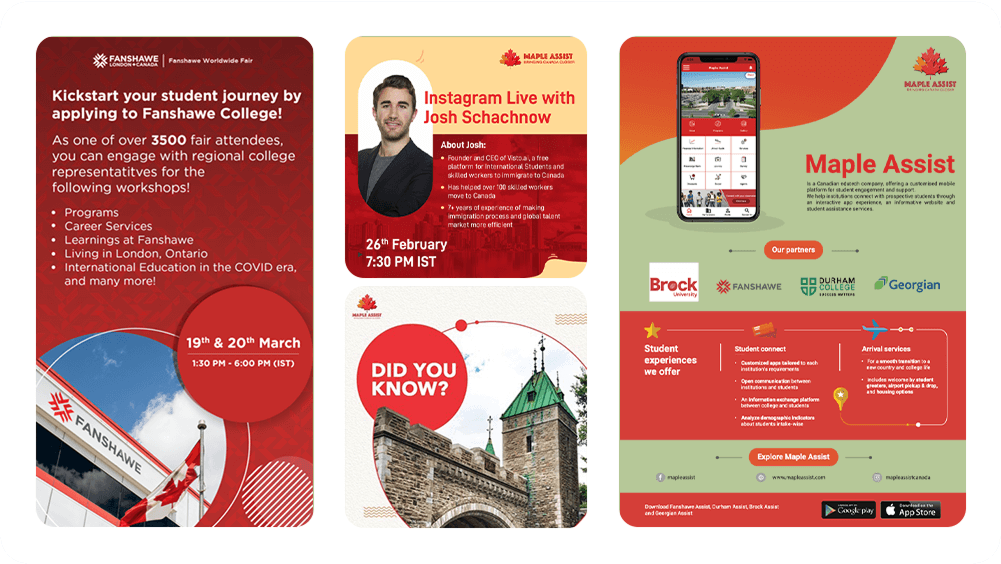
turning-slide1
turning-slide2

The outcome

No single channel did the work. Facebook gave us volume, Quora gave us efficiency, Google gave us intent, and Instagram gave us brand. The mix is what dropped the cost - and a 40% reduction in cost per lead isn't a flat saving, it compounds. Every campaign after month four was buying leads at 40% less than the campaigns before it, which gave Maple Assist the headroom to launch new service lines without going back to their board for more budget.

Then something happened that we don't usually get to tell. As the campaigns worked, Maple Assist's partners noticed. The University of Victoria, Durham College, Scotiabank, Air Canada - institutions Maple Assist was already channeling students and customers toward - began asking who was running the marketing engine on the other side. One by one, we picked up work across that ecosystem. What started as a single client became a Canadian education-sector portfolio. Because marketing for a connector business is never just about the connector. It's about the entire ecosystem it sits inside.

The impact

8 Months
Leads Generated
40% Reduction
CPL
1,500+
Qualified Leads
200MN+
Impressions Achieved

Client testimonial

quote icon quote icon
“Our organisation was in a critical start-up mode, focused on hyper-growth over the next couple of years. What began as a single assignment has grown significantly over time, and Markivis has proven to be an invaluable partner. They brought fresh, innovative ideas to increase our brand visibility and took them all the way through to execution. They worked with us like an internal team, and their expertise across digital campaigns, websites, and marketing collateral has been exceptional.”
Maple Assist


FAQ

How did Markivis reduce Maple Assist's cost per lead?

By balancing four channels - Facebook for volume, Quora ads and organic answers for low-cost intent capture, Google Ads for bottom-of-funnel search, and Instagram for brand engagement. The Quora organic answers program kept generating leads months after publication, lowering blended cost per lead from CA$1.5 to CA$0.9.

Which partners did Markivis support through the Maple Assist engagement?

The engagement extended to several of Maple Assist's Canadian partners, including the University of Victoria, Durham College, Scotiabank, and Air Canada.

What channels were used in the Maple Assist campaign?

Facebook, Instagram, Quora (paid and organic), and Google Ads.

What was the total lead volume?

More than 9,000 leads across platforms in 8 months, with over 1,500 progressing to qualified-lead stages.

Logo
arrow_downward
Scroll To Top